Import Documentation Guide for Used Construction Machinery from China

Bringing new or used construction machinery from China into another country hinges on getting the paperwork right. This guide — written for importers, freight forwarders and project managers — explains the core documents you’ll need, common regulatory hurdles for second-hand heavy equipment, and concise, country-by-country notes covering the nations you asked for. Read this before you sign, ship or pay: good paperwork saves weeks at the port and thousands in unexpected fees.
Table of Contents
1. What paperwork you always need and why
2. Special rules for used construction machinery
3. Quick country-by-country checklist
3.1 Africa
3.2 Middle East
3.3 South America
3.4 Europe & North America
4. Practical workflow and tips
Final paragraph — quick takeaway
Appendix table — Country-by-Country Printable Checklist
1. What paperwork you always need and why
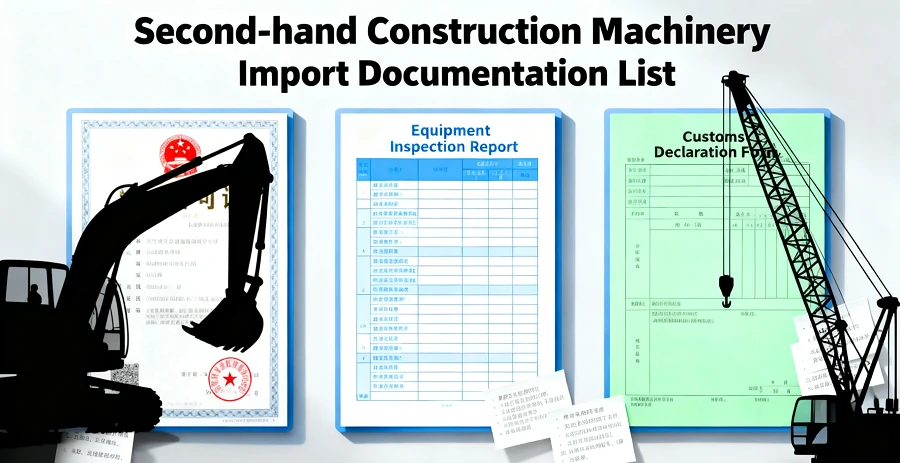
Every port and customs office wants the same basic proof: what the cargo is, where it came from, who is selling it, and who will take responsibility for it on arrival. At minimum prepare:

- Commercial Invoice (seller, price, HS codes, payment terms).
- Bill of Lading / Air Waybill (originals for customs release).
- Packing List (dimensions, weights, serial numbers).
- Certificate of Origin (often required to claim preferential tariffs or meet origin rules).
- Import License or Permit (when the destination requires pre-approval).
- Pre-shipment or destination Inspection Certificate (many countries require inspection for used machinery).
- Insurance Certificate and any safety/emissions compliance documents (where relevant).
These core items form the backbone of most customs clearances; missing one often triggers detention, extra inspections or fines.
2. Special rules for used construction machinery
Used machinery is treated differently from new goods in many jurisdictions. Some governments restrict or ban used imports unless they’re clearly capital goods for production, are below a certain age, or have documentation proving they meet safety or emissions limits.
Brazil, for example, generally restricts imports of used goods but makes exceptions for capital machinery under tight controls; that means you’ll usually need a formal import license and sometimes pre-approval in their SISCOMEX system.
Nigeria and several African customs administrations now require arrival inspection (destination inspections) for many imports, a process that can add time and conditional release requirements — so factor inspection windows and fees into your timeline and budget.

In countries like Kenya, import declarations and certificates of conformity (CoC) for regulated items are standard; you’ll commonly need an Import Declaration Form (IDF), valid invoices and sometimes a PVoC/inspection report.
For the UAE and other Gulf states, make sure your local importer holds the correct trade license (Department of Economic Development / local authority) and verify whether temporary import or re-export regimes could save duties if equipment is only passing through.
3. Quick country-by-country checklist
Below are short, actionable notes for each requested country. Treat these as a starting checklist; always confirm with a local customs broker before shipping.
3.1 Africa
- Zimbabwe — Commercial invoice, bill of lading, certificate of origin; destination inspection possible; taxes & VAT on import.
- DR Congo (Congo-Kinshasa) — Import permit, inspection on arrival, high variability by port; use an experienced clearing agent.
- Republic of Congo (Congo-Brazzaville) — Import declaration, certificate of origin, inspection and port handling fees common.
- Ghana — Import declaration, GRA taxes, pre-arrival documents; older used equipment may face stricter checks.
- Ivory Coast (Côte d’Ivoire) — Import license, commercial invoice, customs duties; certificates required for regulated items.
- Senegal — Import declaration and inspection; some exemptions for project-based imports (government tenders).
- Nigeria — Commercial invoice, original BL, inspection at destination, import license where applicable; engage an NCS-aware broker.
- Kenya — IDF (Import Declaration Form), customs entry, CoC for regulated goods, clearance via iCMS; expect IDF fee (≈2%).
- Angola — Import license, customs valuation & duties, language/document translation may be required.
- Burkina Faso — ECOWAS rules apply; invoice, BL, certificate of origin and regional duty regimes.
- Gabon — Import permit, invoice, inspection possible; check port-specific formalities.
- Cameroon — Import declaration, CBK/inspection, variable port charges and local approvals.
- Mali — Regional rules; invoice, BL, and customs duties — use local agent for up-to-date tariff codes.
- Tanzania — Import declaration, duties, possible inspection and Tanzania Bureau of Standards (TBS) checks.
- Zambia — Clearance via ZRA; invoice, BL, certificate of origin; duties and VAT apply.
- Equatorial Guinea — Limited infrastructure; expect additional handling fees and permit requirements.
- Uganda — URA clearance, invoice, BL, possible inspection and CoC for certain imports.
- Mozambique — Import license and customs entry; inspection and duty/VAT assessment on arrival.

3.2 Middle East
- Saudi Arabia — Importer must comply with SASO standards for some equipment; certificates and conformity may be required; use local agent for SARIE/SASO processes.
- UAE — Importer trade license, BL, invoice, possible temporary entry options and bank guarantees for duty suspension.
- Qatar — Commercial invoice, bill of lading, customs declaration and any industry-specific permits.
3.3 South America
- Brazil — Strict rules for used goods; used machinery often requires an import license via SISCOMEX (RADAR registration) and may be restricted unless classified as capital goods. Plan for paperwork and possible delays.
- Chile — Standard import declaration, invoice, BL; sanitary or emissions checks only if relevant.
- Peru — Import declaration (DUA), invoice, BL; certain machinery may need technical permits.
- Argentina — Import license for many categories, registration requirements and taxes; customs valuation rules apply.
- Mexico — Pedimento (customs declaration), invoice, BL, possible NOM compliance for regulated items.
3.4 Europe & North America (main markets)
- United States — CBP entry, commercial invoice, bill of lading, EPA or DOT rules may apply for engines/vehicles; recall and emissions compliance matters for certain used engines.
- United Kingdom / EU — Import declaration, VAT and duties, CE/UKCA compliance for some safety-critical machinery; used imports may need conformity documents.
4. Practical workflow and tips
- Pre-verify HS codes and duty rates — wrong classification means wrong taxes.
- Request full history from seller — maintenance logs, serial numbers, prior ownership help clear inspections.
- Order inspection BEFORE shipping — independent third-party reports (condition and serial verification) reduce hold-ups.
- Use a local customs broker — local nuance (port practices, surcharges, certificates) saves time and money.
- Prepare translations and notarizations — many customs offices require notarized docs or translations into the local language.
- Budget for inspections & demurrage — inspections, retesting, or late pick-up can multiply costs fast.

Final paragraph — quick takeaway
Importing construction machinery from China is eminently doable — but only if your documentation, local permits and inspection pathways are sorted before the vessel sails. Focus first on the five core documents (invoice, BL, packing list, certificate of origin and the destination’s required permits/inspection certificates), confirm any country-specific used-goods restrictions (Brazil, Nigeria, UAE, Kenya are notable examples) and partner with a local customs broker to turn paperwork into cleared equipment — not a long port headache.
Appendix table — Country-by-Country Printable Checklist
Below is a concise, country-by-country guide to the required documentation, inspection notes, and official customs references for importing construction machinery from China. This resource helps buyers, freight forwarders, and dealers ensure smooth customs clearance worldwide.
| Region / Country | Key Documents Required | Inspection / License Notes | Customs Authority / Reference |
|---|---|---|---|
| Africa | |||
| Zimbabwe | Invoice, Bill of Lading, Certificate of Origin | Destination inspection required; import taxes and VAT apply. | ZIMRA |
| DR Congo (Kinshasa) | Import Permit, Invoice, Packing List | Inspection on arrival; clearing agent strongly recommended. | DGDA |
| Republic of Congo (Brazzaville) | Declaration Form, BL, Certificate of Origin | Pre-inspection and port verification required. | Congo Customs |
| Ghana | Import Declaration, Invoice, BL | Older equipment may face additional inspection. | GRA Customs |
| Ivory Coast | Import License, Invoice, Certificate of Origin | Mandatory pre-shipment verification for used goods. | Douanes CI |
| Senegal | Invoice, BL, Import Declaration | Inspection required; exemptions for project imports. | Senegal Customs |
| Nigeria | Commercial Invoice, BL, Inspection Certificate | Destination inspection; import license may be required. | Nigeria Customs |
| Kenya | IDF, Invoice, CoC | Import Declaration Form (2% fee); Pre-shipment verification (PVoC). | KRA |
| Angola | Invoice, Import License, BL | Portuguese translation often needed. | AGT Angola |
| Burkina Faso | Invoice, BL, Certificate of Origin | ECOWAS duty regime applies. | Burkina Customs |
| Gabon | Invoice, BL, Import Permit | Inspection mandatory; port handling fees apply. | Gabon Customs |
| Cameroon | Invoice, Declaration Form, CoO | Inspection and valuation common. | Cameroon Customs |
| Mali | Invoice, BL, Certificate of Origin | Regional ECOWAS customs rules apply. | Mali Customs |
| Tanzania | Invoice, Import Declaration, CoC | Inspection via TBS required for machinery imports. | TRA |
| Zambia | Invoice, BL, Certificate of Origin | Duties and VAT payable at ZRA. | ZRA |
| Equatorial Guinea | Invoice, BL, Import Permit | Additional handling fees; verify port documentation. | GE Info Portal |
| Uganda | Invoice, BL, CoC | URA clearance; inspection may apply. | URA |
| Mozambique | Invoice, Import License, BL | Inspection and duty payment at port. | Mozambique Customs |
| Middle East | |||
| Saudi Arabia | Invoice, CoC, BL | SASO certification and SABER registration may be required. | ZATCA |
| UAE | Invoice, BL, Importer Trade License | Temporary import possible; duty suspension options exist. | UAE Customs |
| Qatar | Invoice, BL, Customs Declaration | Industry-specific permits may apply. | Qatar Customs |
| South America | |||
| Brazil | Invoice, BL, Import License | Strict limits on used goods; SISCOMEX license needed. | Receita Federal |
| Chile | Invoice, BL, Customs Declaration | Standard process; emissions checks if required. | Aduana Chile |
| Peru | Invoice, BL, DUA Form | Technical permits for certain machinery types. | SUNAT |
| Argentina | Invoice, BL, Import License | Registration & valuation rules apply. | AFIP |
| Mexico | Invoice, BL, Pedimento | Possible NOM compliance for regulated items. | Aduanas MX |
| Europe & North America | |||
| United States | Invoice, BL, EPA/DOT Compliance | Used engines may need emissions certification. | U.S. Customs (CBP) |
| United Kingdom | Invoice, BL, CE/UKCA Docs | Safety and emissions conformity required. | UK Customs |
| European Union | Invoice, BL, CE Declaration | Machinery Directive compliance required. | EU Customs |
⚙️ Tip: Always confirm with your local customs broker before shipping. Requirements can change based on machine type, emission standards, or temporary import rules.